Flat Concrete Roof Waterproofing: An Owner's Guide
Flat concrete roofs leak from ponding water, cracks and failed old coatings. Learn the main waterproofing types, the right working steps and what it costs.

Flat concrete roofs are everywhere in Malaysia: shophouses, modern terrace houses, small office buildings and the roofs of apartment blocks. They look solid, but concrete on its own is not waterproof. Without a good waterproofing layer, rain seeps through fine cracks and eventually shows up as stains, bubbling paint or drips in the top-floor ceiling. This guide explains why flat roofs leak, the common waterproofing options, the correct working steps and what it costs.
Why flat concrete roofs leak
Unlike pitched zinc or tile roofs, a flat roof depends on a gentle fall towards its drain outlets. When any part of that system fails, water no longer leaves quickly.
Ponding water
After heavy rain, check whether any puddles stay for hours or longer. Standing water gives moisture time to soak through cracks and speeds up the breakdown of the waterproofing layer. Ponding usually comes from an incorrect fall or a drain outlet blocked with leaves and dirt.
Cracks in the concrete and screed
Concrete expands and contracts every day with the midday heat and afternoon rain. Over time, hairline cracks form, especially at corners, around pipes that pass through the roof, and at the joint between the roof slab and the parapet wall.
An old coating that has failed
Old waterproofing can peel, blister or turn brittle under the sun. Once it opens up, water reaches the concrete directly. Many owners only notice after the ceiling below starts to stain.
Early signs from inside the building
Before drips appear, a flat roof usually gives a few warnings. Paint on the top-floor ceiling bubbles or flakes, yellowish lines appear along wall corners, or the top room smells damp after rain. In shophouses these signs often show first in the top-floor stairwell or a storeroom nobody visits much. Photograph them, because they help trace the water path.
Common types of waterproofing
No single system suits every roof. The choice depends on the surface condition, whether people walk on or use the roof, and the budget.
Liquid-applied coating
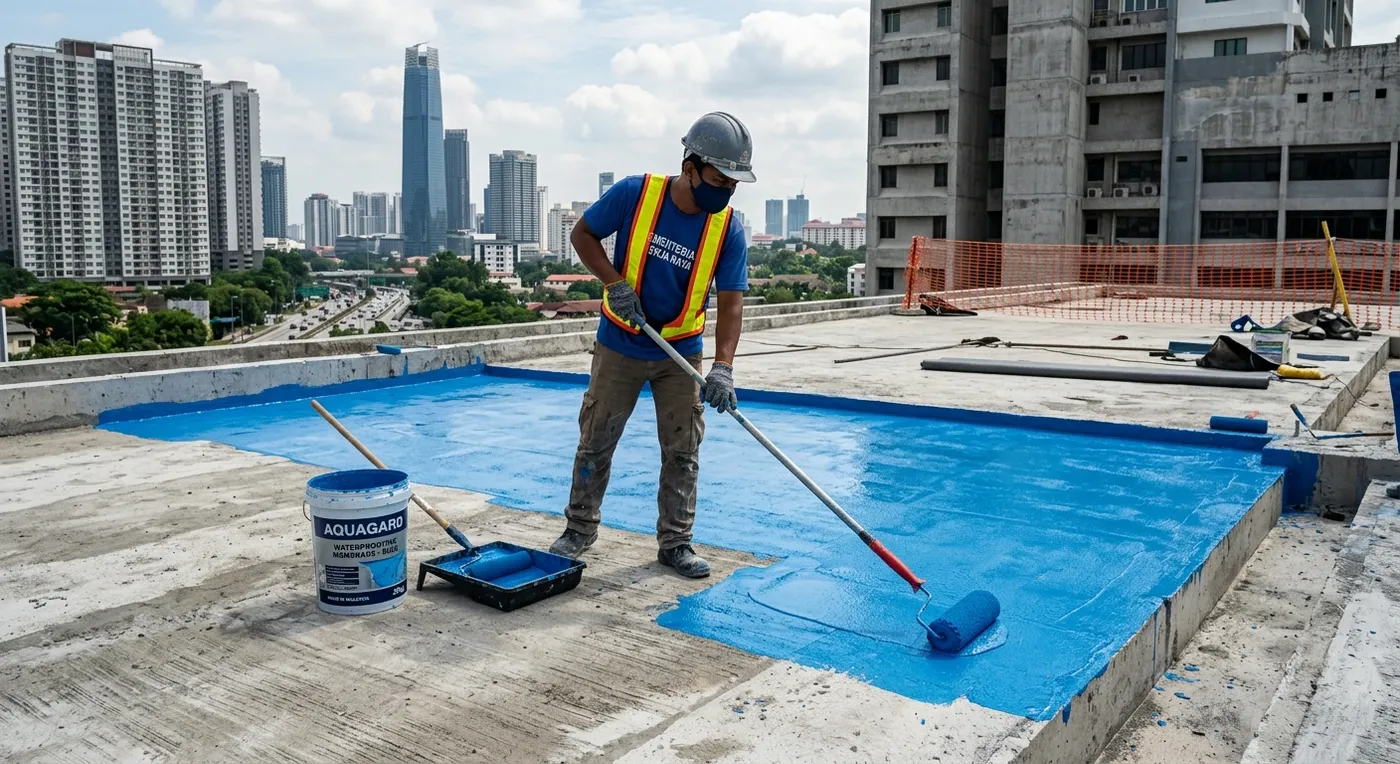
A liquid coating is brushed or rolled on in several coats to form one seamless layer. It suits roofs with many corners, pipes and irregular shapes, because the liquid follows every contour. A reinforcing fabric is usually laid into corners and cracks before the final coats.
Cementitious coating
This type is mixed and applied like a thin plaster. It is often used on areas that will be covered again with tiles or screed. It is less flexible than a liquid coating, so crack preparation has to be more thorough.
Sheet membrane
Membranes come in rolls and are laid with overlapping joints. They suit large, open flat roofs. The joints between sheets are the critical points and must be finished neatly so they do not become water paths.
If the roof is used for drying laundry or holds water tanks or air-conditioner units, choose a system that tolerates foot traffic, or add a walkway so the waterproofing does not wear quickly. Tank stands and air-conditioner brackets also need attention, because they press on or pass through the layer.
The right working steps
Waterproofing results depend heavily on preparation. A new coat laid over a dirty or damp surface will simply peel again.
Inspection and surface preparation
Cleaning and removing the old layer
The surface is cleared of moss, dirt and loose old coating. Blistered sections are cut out and levelled.
Repairing cracks and falls
Cracks are filled and reinforced. Where water always ponds, the fall can be corrected with screed so water moves towards the drain.
Detailing at corners and drains
Most flat roof leaks happen at the edges, not in the middle. The waterproofing has to be turned up the parapet wall, folded neatly at corners and properly joined around drain outlets and pipes. These are exactly the areas a rushed job tends to skip.
Coats and drying time
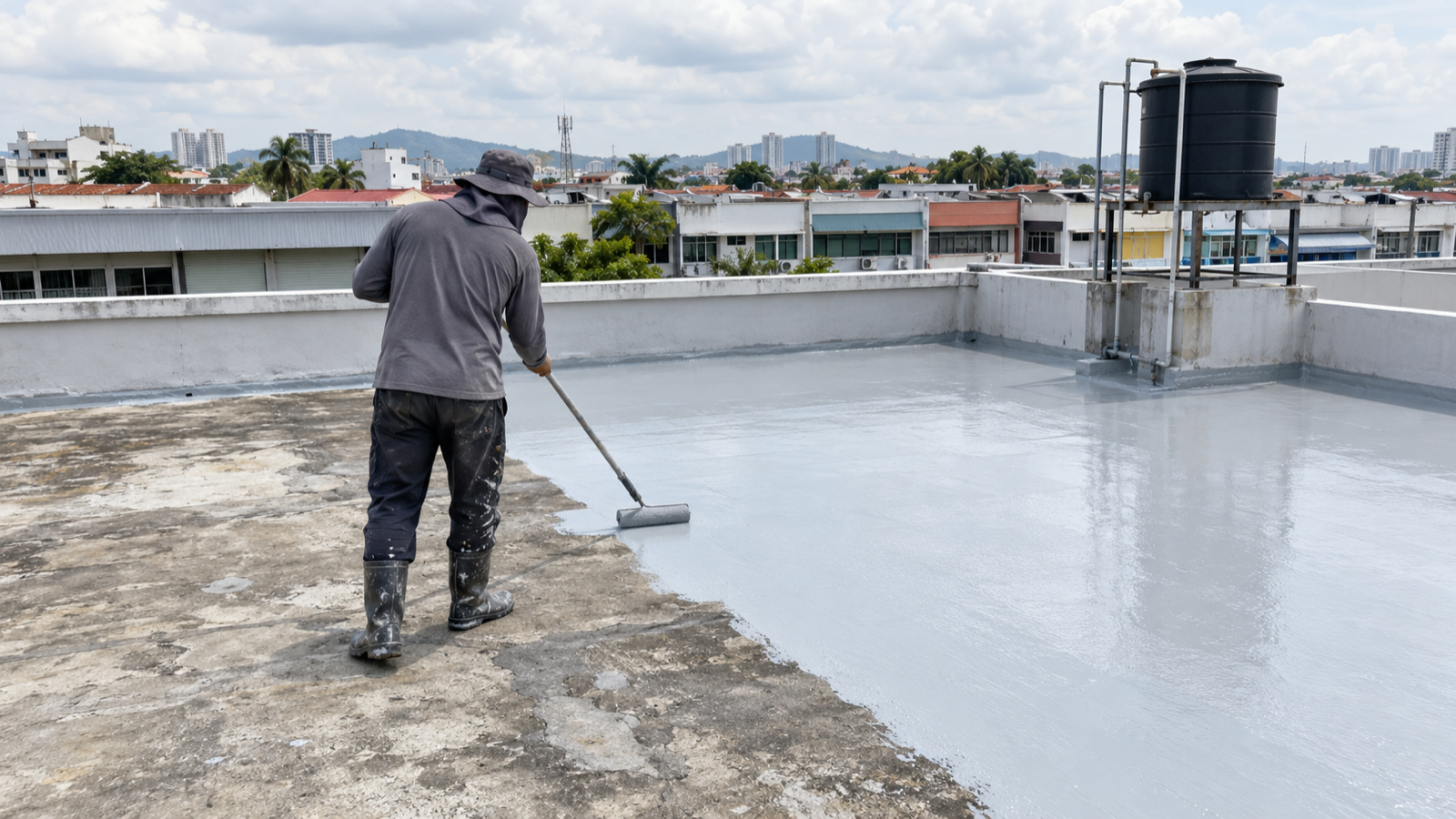
Coatings go on in several coats to the specified thickness, with drying time between each one. The work is best planned for a drier period, because rain before the coat has cured can damage the surface. On the east coast, avoid November to January where possible.
Cost and when to do it
Waterproofing is priced per square foot, so roof size has the biggest effect on the total.
Price ranges
- Concrete roof waterproofing: RM12 to RM20 per sq ft.
- Local leak repair on a concrete roof: RM300 to RM1,000 per job.
- Projects of RM3,000 and above can be paid in instalments of up to 3 months interest-free, with a 30% deposit to start.
See all packages in our price table. For a comparison with other roof types, read roof leak repair costs.
Patch locally or redo the whole roof
If the leak comes from one crack or one drain and the rest of the coating is sound, a local repair is enough. If the old layer is peeling in many places, a full waterproofing job makes more sense, because a new coat laid over a failed one will not bond well.
After the work is done, simple care goes a long way: clear leaves from the drain outlets a few times a year, avoid placing heavy or sharp items directly on the coating, and look over the parapet corners after each rainy season.
Who should check their roof
Top-floor unit owners, building managers and shophouse owners should inspect flat roofs after each rainy season, especially the drain outlets. We carry out free on-site inspections in areas such as Cheras, George Town and Kota Kinabalu. Send photos of the roof, the ceiling below and your location on WhatsApp for an initial estimate.
A flat concrete roof with a sound waterproofing layer and clear drains gives far less trouble. Do not wait for the top-floor ceiling to be ruined before acting.