Leaks Where the Roof Meets the Wall: The Flashing Problem
Water dripping along a wall while the roof looks fine? The cause is often the flashing, the strip that seals the joint between roof and wall.

Many home owners are puzzled when the ceiling gets wet right next to a wall while the zinc or tile roof above looks perfectly fine. In a lot of cases the water is not coming through the roof sheets at all, but through the joint where the roof meets the wall. That joint is covered by a strip called flashing. This article explains what flashing is, why it fails, how to spot the early signs and what the usual repair options are.
What Flashing Is and Why It Matters
The cover where roof meets wall
Flashing is a thin strip of metal, usually zinc, aluminium or a coated sheet, folded to close the gap where a roof surface meets something vertical. You find it along the parapet walls of terrace houses, where a porch roof meets the upper-floor wall of a double-storey home, along shared walls between units, around pipes and chimneys, and where an extended kitchen roof joins the original house.
A roof is designed to shed water downwards. The trouble is that at a wall joint, rain running down the wall drops straight into that gap. Without good flashing, water gets into the ceiling space and travels along the timber truss or beams before it finally drips somewhere.
Common types of flashing
- Apron flashing – a strip at the foot of a wall that covers the top end of the roof, common on porch and extension roofs.
- Step or side flashing – follows the roof slope along the side of a wall, for example on the shared wall of a terrace.
- Counter flashing – a second layer tucked into a groove in the wall that overlaps the lower flashing.
- Cement or mortar flashing – an older method where the joint is simply plastered with cement. It cracks easily once the structure moves a little.
Signs Your Flashing Has Failed
Signs inside the house
The inside signs usually show up first and are the easiest to see:
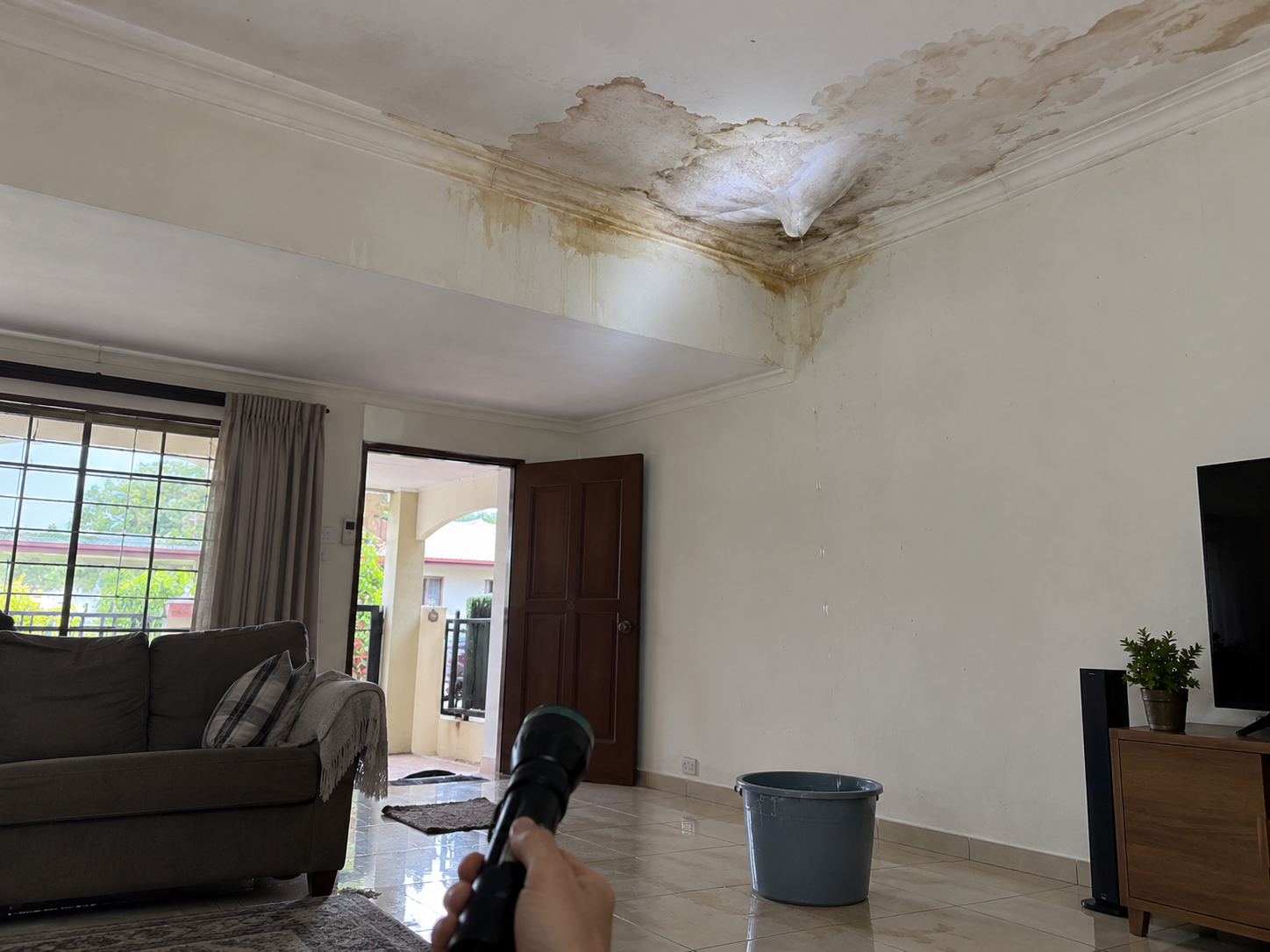
- Yellow or brown stains on the ceiling running along the edge of a wall, rather than in the middle of the ceiling.
- Wall paint bubbling or peeling from the top down, sometimes with streak-shaped water marks.
- Black mould in the upper corner of a room, especially upstairs rooms next to a porch roof.
- Drips only during heavy, wind-driven rain, but not during light drizzle.
Signs outside
If you can see the joint safely from a window or a ladder, look for these:
- Flashing that is lifted, bent or partly torn off, often after a strong wind.
- Rust at the edges or around screw holes, especially on old zinc flashing.
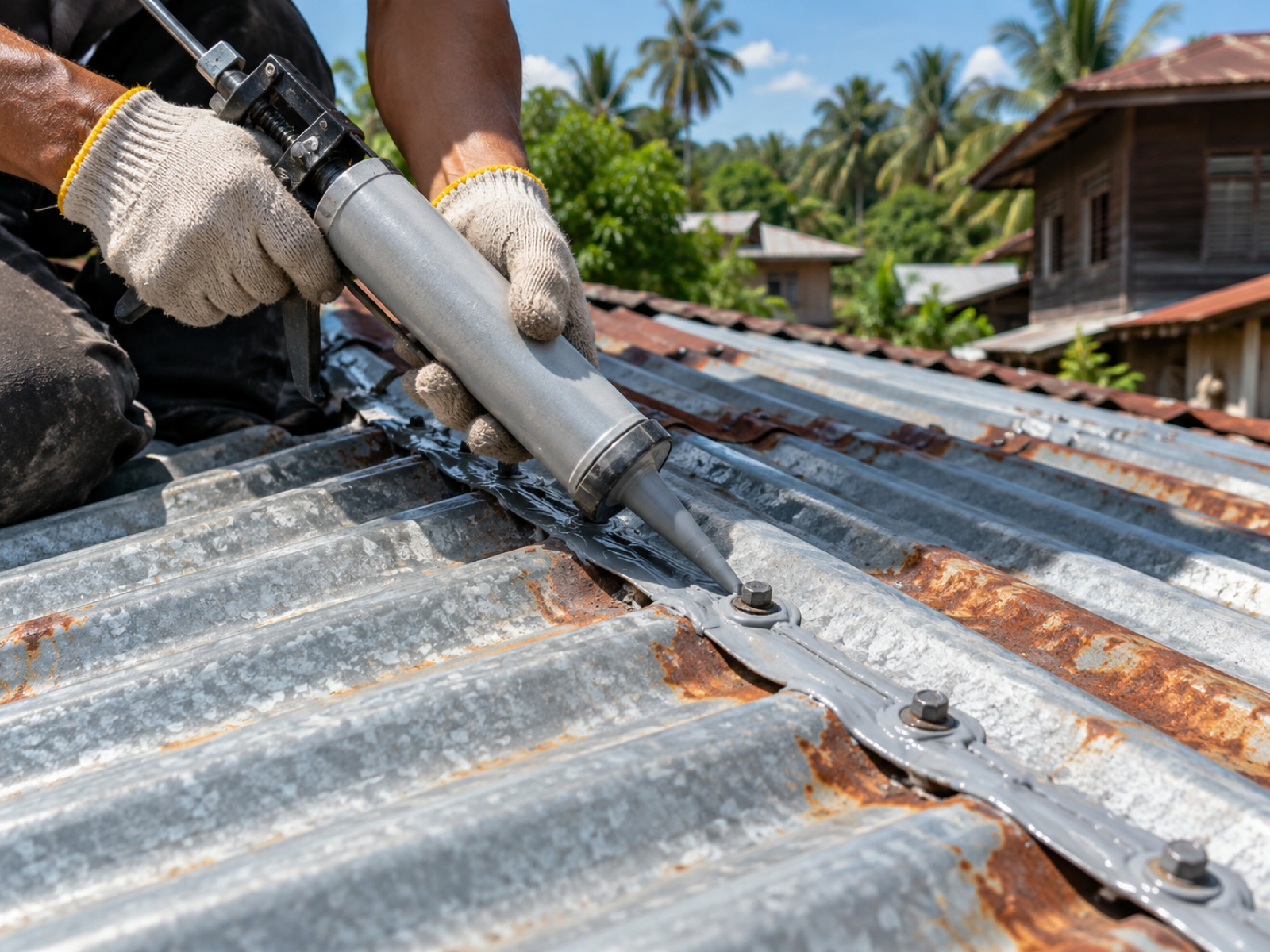
- Sealant or silicone that has cracked, hardened and pulled away from the wall.
- Cement patching that has cracked or fallen out, leaving a gap.
- Moss or dark streaks on the wall just above the joint, a sign that water keeps sitting there.
Please do not climb onto the roof yourself, especially a zinc roof that is slippery after rain or a tile roof that cracks underfoot. Photos from below and from inside the ceiling are enough for a first assessment.
Ruling out other causes
Not every damp patch along a wall is a flashing problem. Cracked external walls, leaking windows and overflowing gutters can look very similar. A blocked gutter, for instance, can push water back up under the roof edge; we cover that in our article on blocked gutters and roof leaks. That is why an on-site check matters before any work starts.
Why Flashing Fails in Malaysia
Hot sun and heavy rain, day after day
Metal expands in the midday heat and contracts when afternoon rain cools it down. That constant movement loosens screws and nails, and the sealant along the flashing edge eventually cracks. In places like Kuala Lumpur and Shah Alam, where afternoon storms are frequent, a joint that has worked loose soon shows it.
Salt air near the coast
Houses close to the sea, such as in George Town or Klang, see metal flashing rust faster. The rust starts at cut edges and screw holes, then spreads until the strip turns brittle.
Renovation work that stopped short
Flashing problems are very common after renovations, such as an extended kitchen roof or an added porch. Sometimes the new joint is only sealed with cement or silicone, without proper flashing. It may last a few rainy seasons before it starts to leak.
How Flashing Is Repaired
Small repairs
If the flashing itself is still sound and only the sealant has cracked, the job usually means removing the old sealant, cleaning the surface, tightening or replacing rusty screws, and applying fresh sealant rated for outdoor use. For this kind of job, roof leak repair starts from RM150 per job.
Replacing the flashing
Flashing that has rusted through, is too short or was installed wrongly needs replacing. A new strip is cut and folded to the shape of the joint, with the top edge set into a groove in the wall or covered by counter flashing, and the bottom edge lapping far enough over the roof that water runs off it.
When cement flashing should go
A joint that is only patched with cement tends to crack again no matter how many times it is re-patched. In that case, switching to proper metal flashing usually lasts better than another round of patching.
When the problem is bigger
Sometimes water that has been getting in for a long time has already rotted the timber truss or boards under the joint. Rotten timber has to be replaced before new flashing goes on. On a flat concrete roof that meets a parapet wall, the joint is usually treated together with the waterproofing layer, which starts from RM12 per sq ft.
How It Works with RoofFix
Step by step
- Send photos of the joint from outside, the affected ceiling and your location on WhatsApp.
- We give an initial estimate based on the photos.
- A free on-site inspection confirms the real cause.
- You get an exact quote before any work begins.
For projects of RM3,000 and above, instalments of up to 3 months interest-free can be arranged, with a 30% deposit to start. You can see our services and starting prices on the services section.